
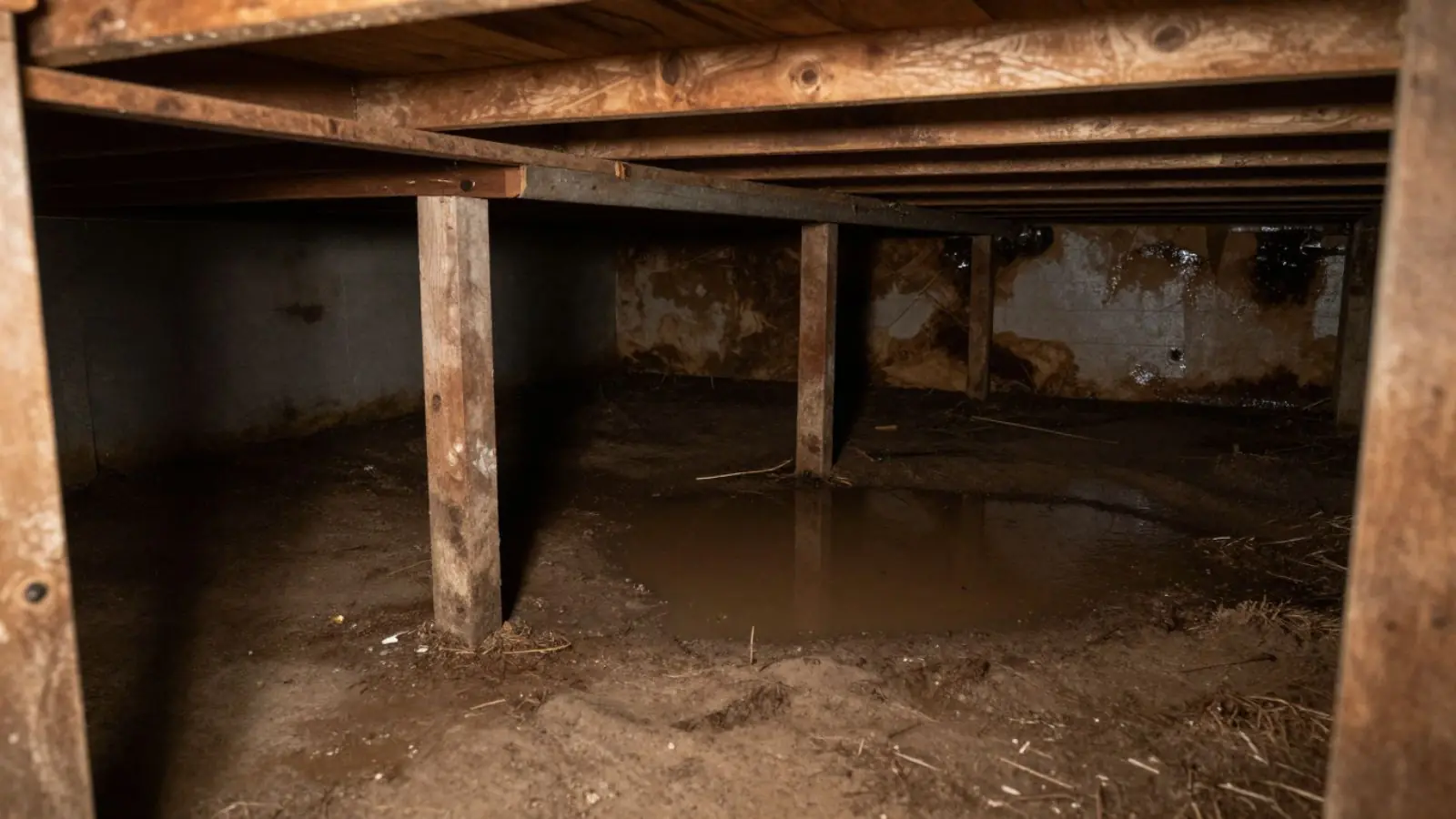
When standing water sits under your floor
If you can see or hear water in the crawl space, call us right away, because this is an emergency. While you wait, stop the source if you can reach it, which usually means the main water valve. Keep people and pets away from the access hatch, and lift stored items near it.
Do not climb in to check. Wiring, ducts and standing water can share the same tight space. We try to book a visit the same day, so tell us what you see from the hatch and we will plan around it.
Crawl spaces are the less common case here
Here is the honest part. Most newer Little Elm homes sit on concrete slabs, so there is no space under the floor to flood. If your home has one, it is probably an older pier-and-beam house, a raised foundation, an addition or an outbuilding.
If your house is on a slab and you are chasing water under flooring, read about slab leak damage instead. That page covers the pipes below the concrete and how water finds its way up.
Need crawl space water damage cleanup in Little Elm?
Call the 24/7 line.
Musty smell, bouncy floor and cupped boards
A damp smell near the floor vents, hardwood that has started to cup, a spongy spot underfoot or a cold draft from the floor often means the crawl space is wet. The trade term is crawl space water damage cleanup, and it starts with getting someone safely under there to look.
Crawl space safety before anyone goes down
- Never enter standing water near wiring. Water and live conductors in a tight space can be deadly.
- Ducts, junction boxes and low cables often run along the joists, so the hazard may be above your head.
- A crawl space is a confined space with little room to turn around or leave quickly.
- Rodents, sharp debris and old nails are common, so gloves and a respirator are the minimum.
- Call us first. We assess from the hatch and decide what is safe to enter.
Electrical, gas and who to call first
If water touches a panel, outlets or any cord, or you smell gas, stay out and call the power company, the gas company or 911 before you call us. Phone (972) 945-2885 once the hazard has been reported.
How we dry out a crawl space
- Crews check access and electrical hazards first, then set up lighting and cords with ground fault protection.
- Submersible pumps move standing water out, and extraction units pull what remains from low spots.
- Saturated insulation is cut away and bagged, since wet batting holds water against the subfloor.
- The vapor barrier, which is plastic sheeting over the soil, is inspected for gaps, tears and pooled water.
- Moisture meters read the joists and subfloor, and a thermal imaging camera shows where moisture spread.
- Air movers and LGR dehumidifiers dry the space and the framing above, and mold watch continues until readings settle.
Large volumes of outdoor water are covered on our flood damage restoration page. If growth has already set in on the framing, mold remediation takes over.
What you see, what it means, what is done
| What you see | What it means | What is done |
|---|---|---|
| Standing water after a storm | Surface runoff or a high water table entered the space | Pump out, dry framing, then flag the drainage question for another trade |
| Dripping or a wet spot under a bathroom or kitchen | A supply or drain line is leaking | Plumber stops the leak, we dry the joists and subfloor |
| Wet, sagging insulation | Water or condensation has soaked the batting | Remove and bag it, dry the cavity |
| Torn or shifted vapor barrier | Moisture is rising from the soil | Document it, dry the space, refer repairs to a specialist |
| Musty smell with no visible water | Moisture may be trapped in framing or soil | Meter readings, targeted drying, mold watch |
Water that came in from outside counts as contaminated under ANSI/IICRC S500, so wet insulation is removed rather than dried in place.
Why spring and fall bring water under the house
NWS Dallas/Fort Worth climate normals list 4.78 inches in May and 4.37 inches in October, the wettest months in a 37.01 inch year. Crawl spaces tend to take on water in those windows. Walk the outside of the house before them and check gutters and downspouts.
Little Elm sits on a flood-control lake, according to the Corps of Engineers, so check the FEMA flood map for your address. Knowing your mapped zone tells you whether to ask your agent about a separate flood policy.
Texas Department of Insurance guidance says mold growth can begin about a day after water arrives. A wet crawl space is dark and still, so that clock matters. Early drying is the best defense, and we do not promise mold will never return.
What drives the cost of crawl space cleanup
| Factor | How it changes the work |
|---|---|
| Water depth and volume | More standing water means longer pumping and more extraction |
| Insulation and materials | Wet batting must be removed, and the amount depends on the space |
| Access and height | Tight hatches and low clearance slow every task |
| Drying days and equipment | Dense joists and humid weather mean more air movers and LGR dehumidifiers for longer |
| Repair scope | Subfloor, flooring and any plumbing repair are separate from the drying |
Insurance may respond to sudden plumbing leaks, and outside flood water is usually excluded without a separate flood policy. Check your policy and ask your insurer. Want your real number? Call (972) 945-2885.
What we leave to other trades
We dry and restore. We do not regrade a yard, install drainage or encapsulate a crawl space. A foundation or waterproofing contractor does that work, and it matters if the space fills again after every storm.
We serve homes beyond town lines too, including Aubrey to the north and Prosper to the west, where older raised homes sometimes show the same trouble.
Mistakes to avoid under the house
- Climbing in to look while water stands near wiring.
- Running a household fan or dehumidifier through the hatch and calling it dry.
- Covering wet insulation with new plastic sheeting.
- Making permanent repairs before your insurer has seen the damage.
Need crawl space water damage cleanup in Little Elm?
Call the 24/7 line.
Frequently Asked Questions
Is emergency crawl space water damage cleanup available in Little Elm during a storm night?
Yes. We answer at 2 a.m. the same as noon, and we can often get someone out today, schedule permitting, including nights and weekends. Call first, keep out of the crawl space and tell us what you can see from the hatch.
Does my house even have a crawl space?
Many newer Little Elm homes are built on concrete slabs and have none. If yours is older, raised or has an addition, look for an access hatch in a closet or on an outside wall, or small vents along the foundation.
My floor feels soft but I have a slab. Is this the right page?
Probably not. Slab homes have no crawl space, and soft floors there usually point to a pipe leak or water from the walls. Our slab leak page covers that case.
Can I go down and look at it myself?
We advise against it. Standing water near wiring, ducts and tight clearance make it unsafe. Call us, and we will decide what is safe to enter.
Will you waterproof or encapsulate the crawl space?
No. We pump, remove wet materials and dry. Regrading, drainage and encapsulation belong to a foundation or waterproofing contractor.
How do I know if mold has started?
A musty smell and dark spots on framing are warning signs. For testing, ask a licensed assessor, and take health questions to a physician.