
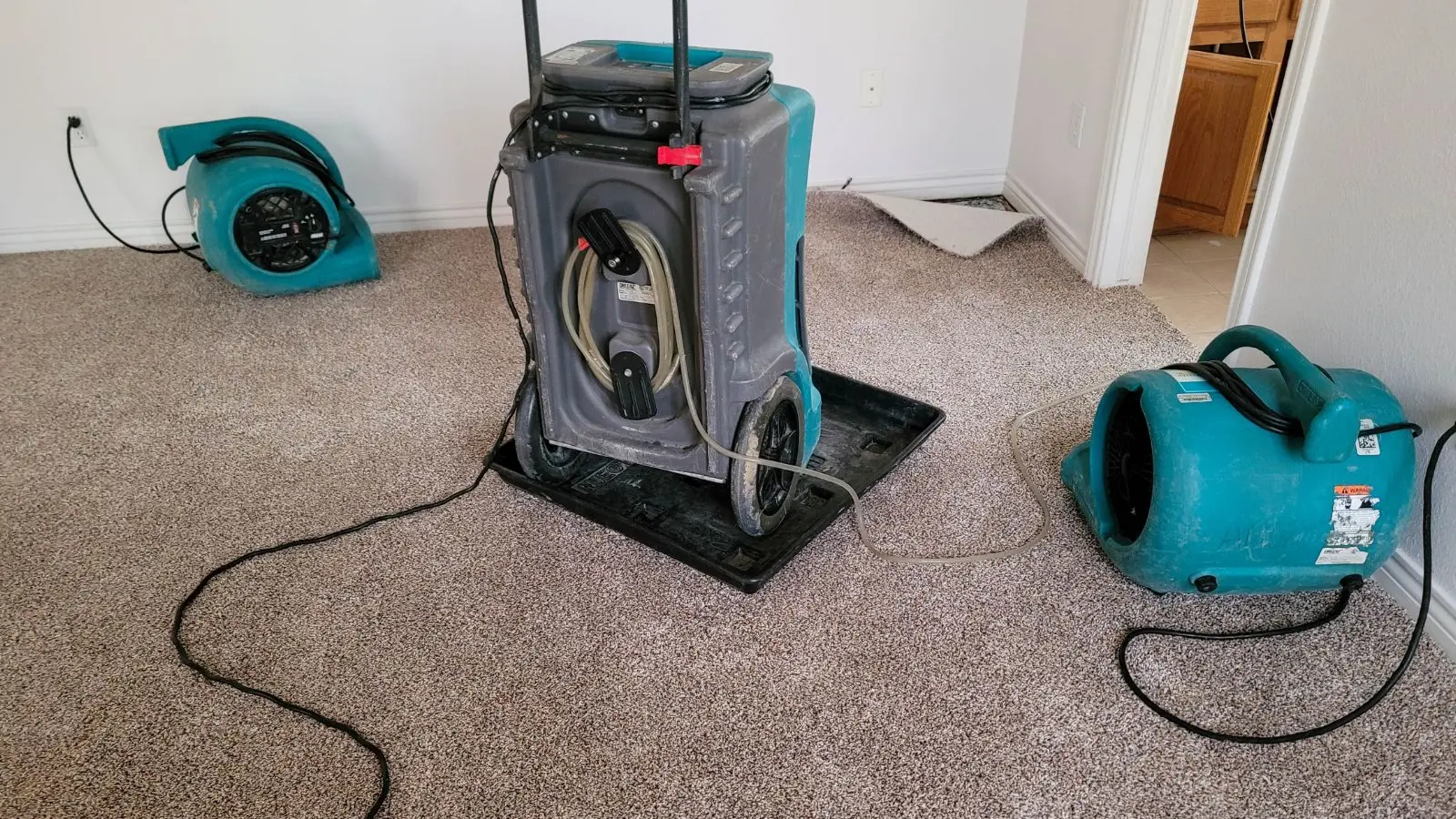
What structural drying is and why it takes equipment
Structural drying removes moisture from the building itself, not just the surface. That means studs, plates, subfloor, drywall, insulation, cabinets and slab. Materials that look dry can still hold water inside, and that water feeds mold and warps wood.
Texas Department of Insurance guidance says mold may start taking hold within roughly a day of a leak, so drying speed matters. The first 24 to 72 hours of emergency steps live on our water mitigation page, and removing the standing water is covered on emergency water removal.
Walls that still feel cool and damp days later
A baseboard that still feels cold, a floor that stays tacky, a musty smell after the puddle is gone or paint that keeps bubbling all say the same thing. The wet is still inside the wall or under the floor. The trade term for what fixes it is structural drying.
Need structural drying and dehumidification in Little Elm?
Call the 24/7 line.
Water classes, from small spills to deep saturation
ANSI/IICRC S500 describes four water classes by how much wet material is involved and how fast it releases moisture. Class tells us how much drying capacity a job needs, and it is separate from water category, which tells us how contaminated the water is.
| Class | What it describes | Typical example | What it means for drying |
|---|---|---|---|
| Class 1 | Least amount of water, low-porosity materials | A small spill on a section of floor | Light airflow and dehumidification |
| Class 2 | Larger area, carpet and pad wet, water wicked into walls | A room soaked by a supply line leak | More air movers, wall cavity drying |
| Class 3 | Water from above, insulation and ceilings saturated | A ceiling leak that soaked a whole room | Overhead and wall drying at scale |
| Class 4 | Deep saturation of low-porosity materials | Hardwood, plaster or concrete holding water | Longer, specialized drying plans |
Drying equipment and what each piece does
| Equipment | Job it does | Where it fits |
|---|---|---|
| Air movers | Push air across wet surfaces to lift moisture | Floors, walls and carpet |
| LGR dehumidifiers | Pull water vapor out of the air so materials keep releasing moisture | Closed rooms and whole floors |
| Moisture meters | Read moisture in drywall, wood and subfloor | Every wet material, every visit |
| Thermal imaging cameras | Show cool, wet areas behind surfaces | Finding hidden water |
| Wall cavity and subfloor drying setups | Move dry air through enclosed spaces | Behind baseboards and under floors |
Equipment count depends on wet area, class, materials and ceiling height. There is no fixed ratio, which is why one house needs far more than another of the same size.
Why a box fan and a household dehumidifier fall short
A box fan moves air but cannot reach inside a wall cavity or under a subfloor. A household dehumidifier is small and sits in open space. Neither measures progress, and neither is built to run for days against a soaked structure.
LGR units pull far more water from the air, and air movers are placed to drive moisture out of specific surfaces. Moisture meters then show whether it is working. Without readings, a room only feels dry.
Safety around drying equipment
- Do not unplug or move equipment on your own. Placement, power draw and airflow are set for a reason.
- Keep children and pets away from cords, intake grilles and hot exhaust.
- Keep cords out of standing water, and tell us if you see water near outlets.
- If water touches a panel or you smell gas, call the utility or 911 before you call us.
- Keep doors and windows closed so the dehumidifiers work on the wet air, not the whole outdoors.
Call (972) 945-2885 if a unit stops, trips a breaker or makes a new noise, and we will advise what to do.
How the drying job runs from first day to pickup
- Moisture meters and thermal imaging cameras map the wet materials and set a baseline.
- Air movers and LGR dehumidifiers are placed, and wall and subfloor cavities are opened where needed.
- Crews return to log temperature, humidity and moisture readings and adjust equipment.
- A dry standard is set by comparing readings against similar unaffected materials in the same building.
- Equipment comes out only when the logged readings reach that standard.
Drying takes days, and the readings decide when it ends, not the calendar. We do not promise a day count.
Humid air, tight homes and slow drying
NWS Dallas/Fort Worth climate normals show May near 4.8 inches and October near 4.4 inches, the wettest months. Humid air slows drying, so keep doors closed and let the dehumidifiers run.
Census numbers for Little Elm climbed from 25,898 in 2010 to 46,453 in 2020. Many of those homes are newer and built tight, which holds humidity. Ask about ventilation and whether the air handler can run safely during drying.
We also serve nearby Prosper and The Colony, where newer tight construction is common too.
What drives the cost of structural drying
| Factor | What it does to the scope |
|---|---|
| Wet area and class | More wet square footage and higher classes need more equipment |
| Materials affected | Hardwood, plaster and concrete dry slower than drywall |
| Ceiling height | Taller rooms hold more air to dry |
| Drying days | Equipment stays until readings meet the dry standard |
| Monitoring visits | Daily readings and logs mean return visits |
Insurance often responds to sudden and accidental water, while gradual leaks are often excluded. Check your policy and ask your insurer, and keep the daily logs because they document the work. Want your real number? Call (972) 945-2885.
Mistakes to avoid while the equipment runs
- Turning equipment off to save noise before the readings say dry.
- Opening doors and windows on a humid day.
- Closing up walls while cavities are still wet.
- Judging dryness by touch alone.
- Rebuilding before the logs show the dry standard.
Need structural drying and dehumidification in Little Elm?
Call the 24/7 line.
Frequently Asked Questions
Can you start drying the same day, or only in an emergency?
A same-day visit is often possible, and our dispatch line runs 24/7. Call, tell us what got wet, and we will explain what can start today and what to do while you wait.
How long will drying take?
It takes days, and the readings decide. We log moisture, temperature and humidity and remove equipment only when materials reach the dry standard. We do not promise a number of days.
Why not just run a box fan and a dehumidifier from the hardware store?
Those tools cannot reach inside walls or subfloors, and they give no readings. Drying equipment is placed to a plan and checked with meters.
Why is the equipment so loud and warm?
Air movers push air at speed and LGR dehumidifiers give off heat as they pull water from the air. That is normal during structural drying.
How many fans and dehumidifiers will my house need?
It depends on wet area, class, materials and ceiling height. There is no fixed ratio, and we adjust equipment as readings change.
Will drying stop mold from growing?
Drying removes the moisture mold needs, which is why speed matters. We cannot promise mold will never return, and mold questions belong on our mold remediation page.